Remember when Nvidia was “just the graphics-card company”? Those days are gone.
In FY 2025 the green-eyed tech giant quietly racked up US $1.7 billion in automotive revenue—55 % higher than last year.¹ That figure may sound tiny next to the firm’s data-center bonanza, but it signals a bigger story: cars are racing toward the same AI revolution that swept smartphones and PCs, and Nvidia is staking out pole position.
From Dashboards to Digital Brains
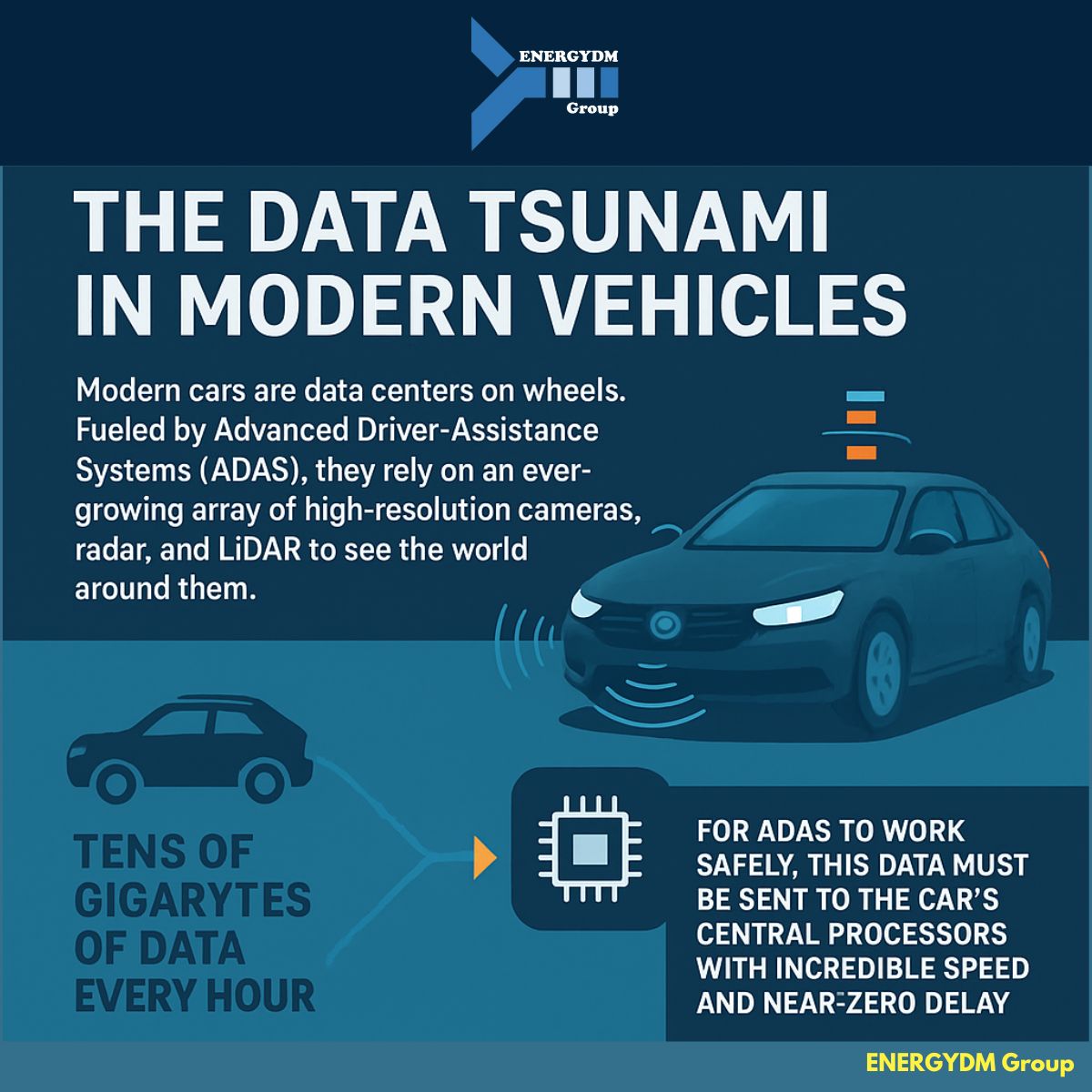
Early wins came from snazzy instrument clusters and infotainment displays. Today, Nvidia’s DRIVE Orin chip has morphed into the “central nervous system” of premium vehicles, juggling up to 254 TOPS of AI horsepower. Four of those chips run in tandem inside NIO’s flagship sedan—a full trillion operations per second sitting under one hood!
But raw silicon is just the first lap. Nvidia pairs its hardware with:
- Drive OS & DriveWorks – an automotive-grade, safety-certified operating system and AI tool kit.
- Omniverse & DRIVE Sim – a Hollywood-quality digital twin of every road scenario engineers need to test.
- AI “factories” – DGX servers that train the car’s neural nets before a wheel ever turns.
Put it together and you get a one-stop shop that helps automakers develop, test and update autonomy features faster than most could manage alone.
Meet the New Pit Crew: Mercedes, Toyota & Friends
1. Mercedes-Benz – Level 3 trail-blazer
The S-Class and EQS already offer the industry’s first SAE Level 3 “Drive Pilot,” powered by Orin and Nvidia’s full safety stack. This year Mercedes begins rolling the tech across its entire line-up—right down to the compact CLA—while sharing revenue with Nvidia on every future over-the-air upgrade.
| Why OEMs Sign On |
|---|
| ✔ Faster road to market – The base stack is already ASIL-D certified. |
| ✔ Upgradeable business model – Hardware has extra headroom, letting brands sell new features by subscription. |
| ✔ Developer familiarity – Millions of CUDA/Linux engineers can jump in without steep learning curves. |
Thor on the Horizon
Orin’s follow-up, DRIVE Thor, arrives in 2025 with up to 2,000 TOPS (roughly 8 × PlayStation 5s in one chip). That’s enough to run the self-driver, the 3-D dashboard and a full Unreal-Engine game all at once—yet automakers need only one board instead of three separate computers.

Opportunity, Obstacles and the Road Ahead
Why the Growth Engine Still Has Mileage
- Regulations are shifting – Euro NCAP, U.S. NHTSA and China’s MIIT are nudging every new model toward more standard ADAS. More ADAS ⇒ more compute.
- Software-defined cars – Like your phone, vehicles will live on new apps and OTA upgrades. Nvidia’s Tier 1.5 approach lets OEMs flip those digital switches (and revenue taps) quickly.
- Factory AI – The same GPUs that drive the car are running inspection cameras and welding robots on the production line, knitting Nvidia even deeper into the value chain.
Analysts peg Nvidia’s auto run-rate at ~US $5 billion by FY 2026,² with upside toward US $8-10 billion later in the decade if higher-level autonomy goes mainstream.

Speed Bumps to Watch
| Challenge | Why It Matters | Nvidia’s Counter-Move |
|---|---|---|
| Local rivals in China (Horizon Robotics, Huawei) | Lower-cost chips threaten volume wins in the world’s biggest EV market. | Focus on premium segments, partner with Foxconn for local manufacturing, and keep performance lead. |
| Export-control headwinds | U.S. restrictions could one day cover high-end auto AI. | Offer “China-custom” variants and diversify fabs. |
| Thermal & power budgets | 2,000 TOPS = lots of heat in an EV’s frunk. | Advanced 5 nm process, smart power management, liquid-cooling reference designs. |
| OEM fear of lock-in | Car brands want differentiation, not a black box. | Modular software, open APIs, co-development (e.g., Mercedes MB.OS). |
Bottom Line
If cars are turning into rolling super-computers, Nvidia is angling to be their Intel and their Windows and their AWS—all at once. The company hasn’t won every contract (Qualcomm and Mobileye still hold key accounts), but the momentum is undeniable.
So the next time your friend brags about hands-free cruising or a dashboard that levels up after a midnight update, you’ll know the quiet hero might just be hidden under an emerald-green logo.
References
¹ Nvidia FY 2025 earnings release, Automotive & Robotics segment.
² Nvidia investor call, Q1 FY 2026 outlook.