RivianOS 2 is more than a software update. It represents an important part of Rivian’s broader market strategy: making electric vehicles more scalable and affordable.
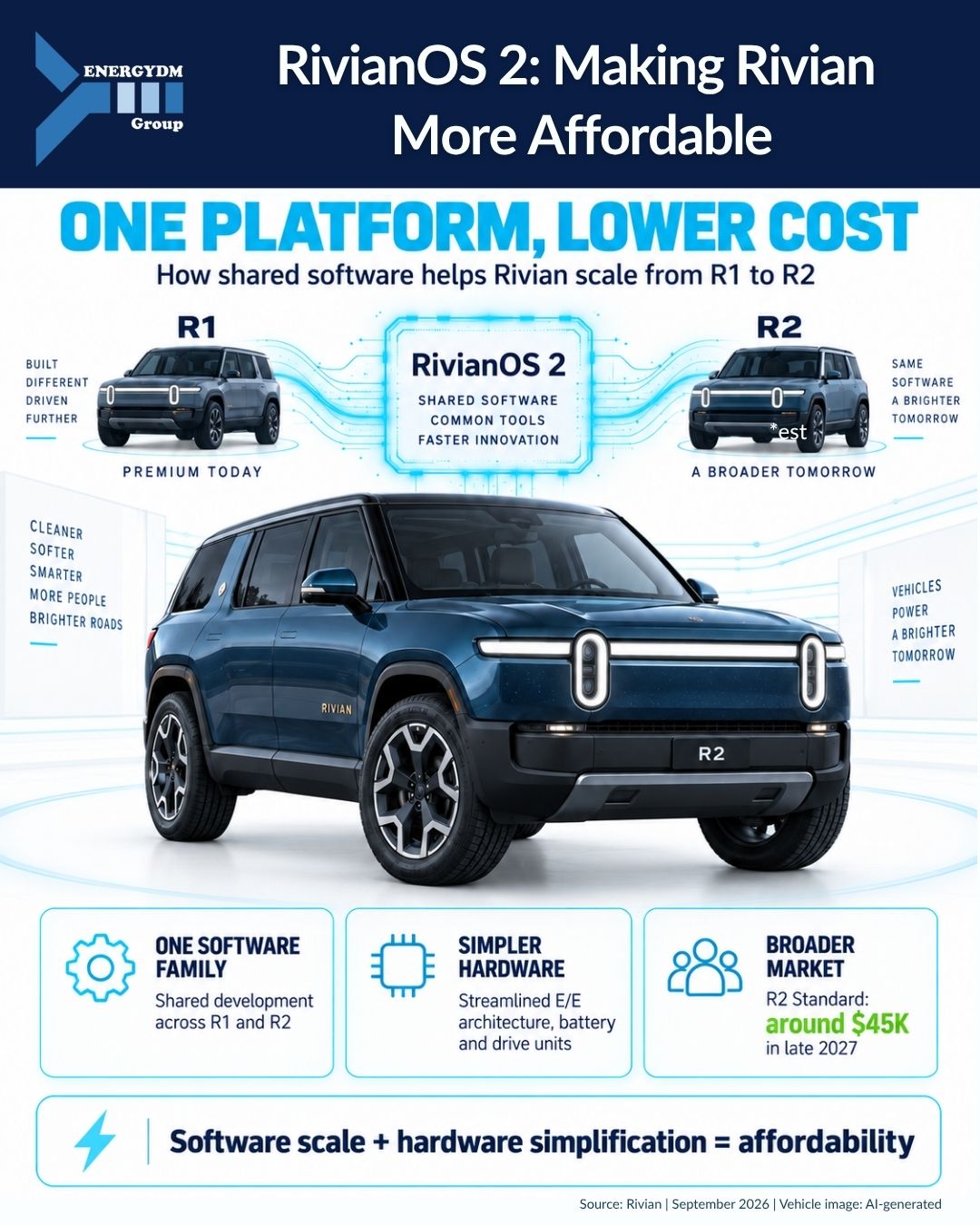
The new software approach enables greater unification across the R1 and R2 models. By sharing a common software foundation, Rivian can reuse development across different vehicles, accelerate future updates, and reduce overall software complexity.
This becomes particularly important as Rivian moves beyond its premium R1 vehicles and expands into the more accessible R2 platform.
Software Reuse Meets Hardware Simplification
Software is only one part of the equation. Rivian is combining its software strategy with a simplified E/E architecture, greater compute consolidation, a structural battery pack, and simplified propulsion options.
Together, these changes can help reduce vehicle complexity and create greater reuse across different models and configurations.
This is also where the transition toward a Software-Defined Vehicle becomes a business discussion—not simply a technology discussion.
A common software and E/E foundation can potentially allow an OEM to develop functionality once and scale it across multiple vehicles, rather than treating every new vehicle program as an independent development effort.
Affordability Goes Beyond Battery Cost
For years, the EV affordability discussion has focused heavily on battery costs, manufacturing scale, and supply chains. Those factors remain critical, but they are not the whole story. Software scalability and hardware simplification can also become important cost levers.
Rivian’s strategy illustrates this well. The combination of software reuse, a more centralized E/E architecture, simplified hardware, battery integration, and manufacturing efficiency is intended to support a broader and more affordable vehicle portfolio. This includes the R2, which is central to Rivian’s effort to reach a much larger market.
The takeaway is simple: the next generation of affordable EVs will not come from cheaper batteries and manufacturing alone. Software scalability across different models and hardware simplification will play important roles, too.