EV powertrains have consolidated cooling and lubrication into a single fluid loop. What that fluid has to do (all at once!) turns out to be one of the more underappreciated engineering challenges in electrification.
The electrification story tends to skip the chemistry. Batteries, software, silicon…that’s where the attention goes.
But inside every electric drive unit (EDU) there is a working fluid managing three simultaneous jobs: lubricating high-speed reduction gears, cooling the motor stator, and maintaining dielectric strength around energized copper windings. No single conventional automotive fluid was ever designed to do all three.
Three jobs. One fluid. The physics don’t cooperate.
Start with the gear lubrication requirement. A typical single-speed EV reducer runs its input shaft at 15,000–20,000 RPM, with gear tooth contact pressures that can exceed 1 GPa. That calls for extreme-pressure (EP) additives (usually sulfur- or phosphorus-based compounds) to maintain a protective tribological film.
The problem: those same EP additives are chemically aggressive toward copper. And the motor stator, wound with copper wire coated in thin varnish insulation, sits in the same fluid circuit. Additive packages that protect the gears can corrode the winding insulation over time, accelerating the very failure mode the fluid is supposed to prevent.
Motor cooling adds viscosity tension. Lower kinematic viscosity improves heat transfer and reduces churning losses in the gearbox but also thins the elastohydrodynamic (EHD) film at the gear tooth contact. Most EDU fluids land in the ISO VG 32–46 range (roughly 5–8 cSt at 100°C), chosen to balance these competing demands across the full operating envelope.
Then there is the dielectric requirement. Motor stator windings are rated to thermal insulation classes — Class F (155°C), Class H (180°C), Class C (220°C+) — and when a fluid wets those windings directly, it becomes part of the insulation system. A fluid with poor dielectric breakdown voltage can trigger partial discharge between winding turns, degrading insulation until turn-to-turn shorts develop. High-performance synthetic EDU fluids now reach 80–100 kV/mm under IEC 60156 testing; conventional mineral gear oils sit at 30–50 kV/mm. The gap matters.
The solution space is narrow: fully synthetic base stocks (PAOs and ester blends), with additive packages reformulated to provide gear protection without copper corrosion — typically phosphate-ester-based EP systems or surface-active friction modifiers in place of aggressive sulfurized compounds.

What the thermal architecture is actually asking for
Modern EV thermal management runs three loops: a low-temperature glycol circuit (~15–25°C) for the battery pack, a higher-temperature loop (~65–80°C) for the drive unit and power electronics, and a refrigerant circuit for the cabin.
Within the drive unit loop, the question is whether to cool the motor externally through a water-glycol jacket or to route a dielectric fluid directly through the stator. Water-glycol wins on thermal conductivity (0.4–0.6 W/m·K versus roughly 0.15–0.18 W/m·K for typical EDU oils). But direct oil cooling eliminates the jacketed water circuit, the dedicated pump, the plumbing, and the sealing interfaces. The mass and complexity savings are real, and the thermal conductivity gap narrows considerably when oil is sprayed or jetted directly onto the end windings at sufficient flow rate.
This is why direct oil cooling works best when the motor is designed for it from the start not as a retrofit to a geometry originally built around external jacket cooling.
Fleet data: 100,000 km in the real world
Lab specifications are a starting point. The interaction between thermal cycling, oxidation, additive depletion, and mechanical wear is difficult to model without real operating conditions and real miles.
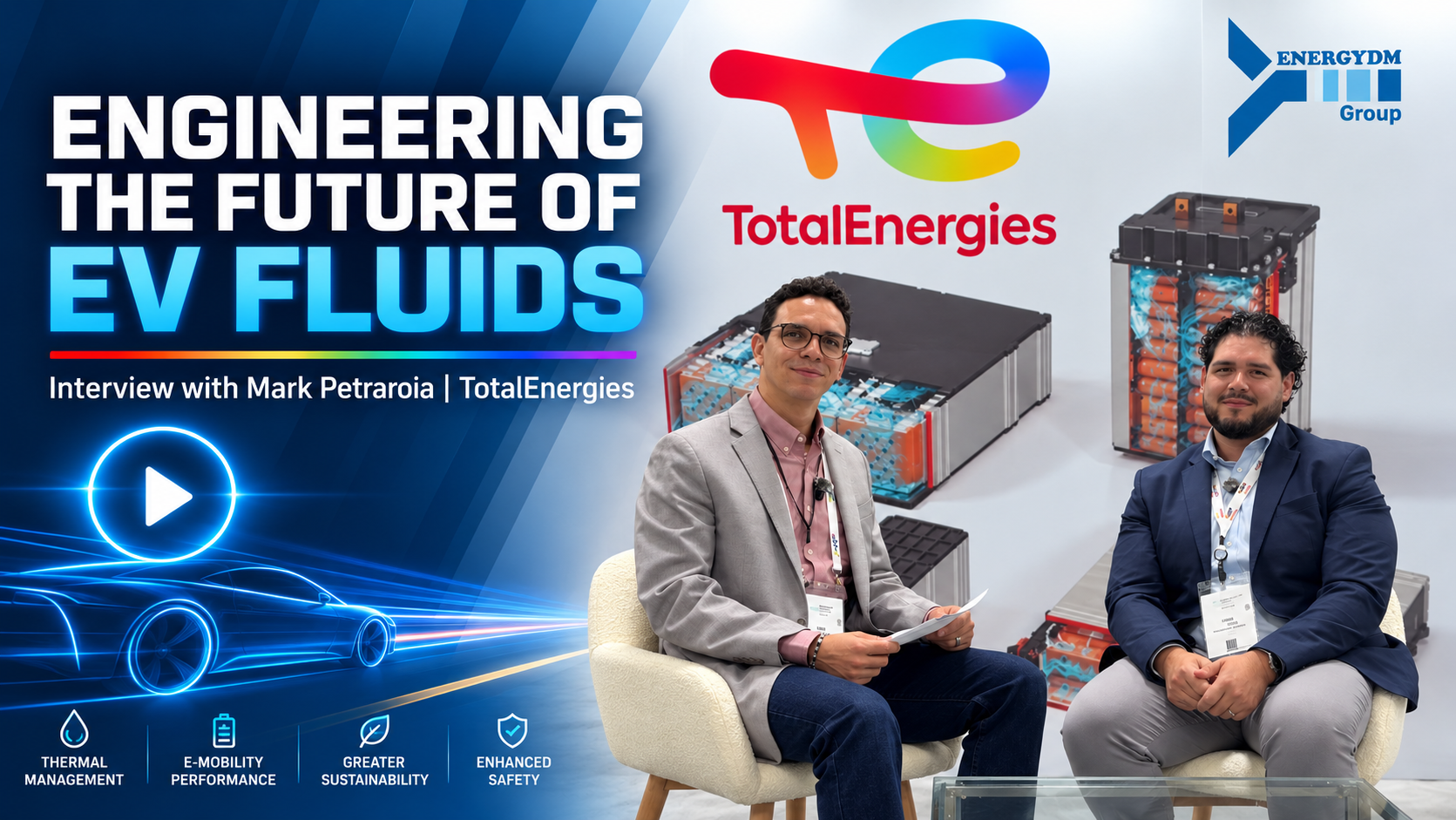
A useful reference dataset comes from a validation study run by TotalEnergies and fleet operator GETEC on Tesla Model 3 vehicles operating in Germany and China — two matched groups, one on the OEM reference fluid, one on TotalEnergies’ Quartz EV-Drive MP synthetic EDU formulation. High-utilization duty cycles: six-plus days per week, two shifts per day, mixed slow and fast charging. After 100,000 km:
– Viscosity at 100°C held at approximately 4.7 cSt in the test group throughout the campaign — below the reference fluid and with negligible drift. Viscosity creep under thermal oxidative stress is a primary degradation mode for EDU oils; flat retention across the full mileage range indicates the antioxidant and base stock chemistry stayed intact under load.
– Wear debris (spectrometric oil analysis) showed slower iron and copper accumulation in the test group. Post-campaign teardowns found no corrosion on magnet wire varnish and no slot liner degradation — a meaningful result given the copper-compatibility trade-off in the additive design.
– Efficiency delta: approximately 0.38 Wh per CLTC cycle versus the OEM fluid. The China Light-duty vehicle Test Cycle is urban-weighted, where low-speed viscous losses dominate; the result aligns with the lower 100°C viscosity of the test fluid. Small per cycle, meaningful at scale.
The physical layer the software story depends on
The dominant industry narrative runs through software, compute, and AI. That narrative is not wrong. But the vehicle still has to move, and the EDU still has to run reliably across a 15-plus-year service life. The chemical and thermal physics underneath determine whether the silicon and software can deliver on their promises in the field.
Drive unit fluid is part of that foundation. The shift to unified dielectric fluid architectures carries measurable implications for powertrain packaging, service interval design, warranty modeling, and long-term motor reliability. Engineers in EDU and thermal systems know this well. The broader conversation around EV and AI-defined vehicle development should catch up.
Electrification did not make vehicle fluids irrelevant. It made them harder to get right.
Sources
TotalEnergies Quartz EV-Drive MP and EV-Battery product literature;
TotalEnergies / GETEC 100,000 km fleet validation (Germany & China cycles);
IEEE Std 43-2013 (Motor Winding Insulation Testing);
IEC 60156 (Dielectric Breakdown of Insulating Liquids);
Fortune Business Insights EV Fluids Market 2026–2034;
Spherical Insights EV Dielectric Fluid Market 2025–2035;
IDTechEx Thermal Management for Electric Vehicles 2026–2036.