A closer look at the quiet revolution happening inside your electric drive unit.
There’s a comforting myth that EVs are fluid-free. No oil changes. No transmission service. Just plug in and roll. It’s a great pitch, but it’s not quite the truth.
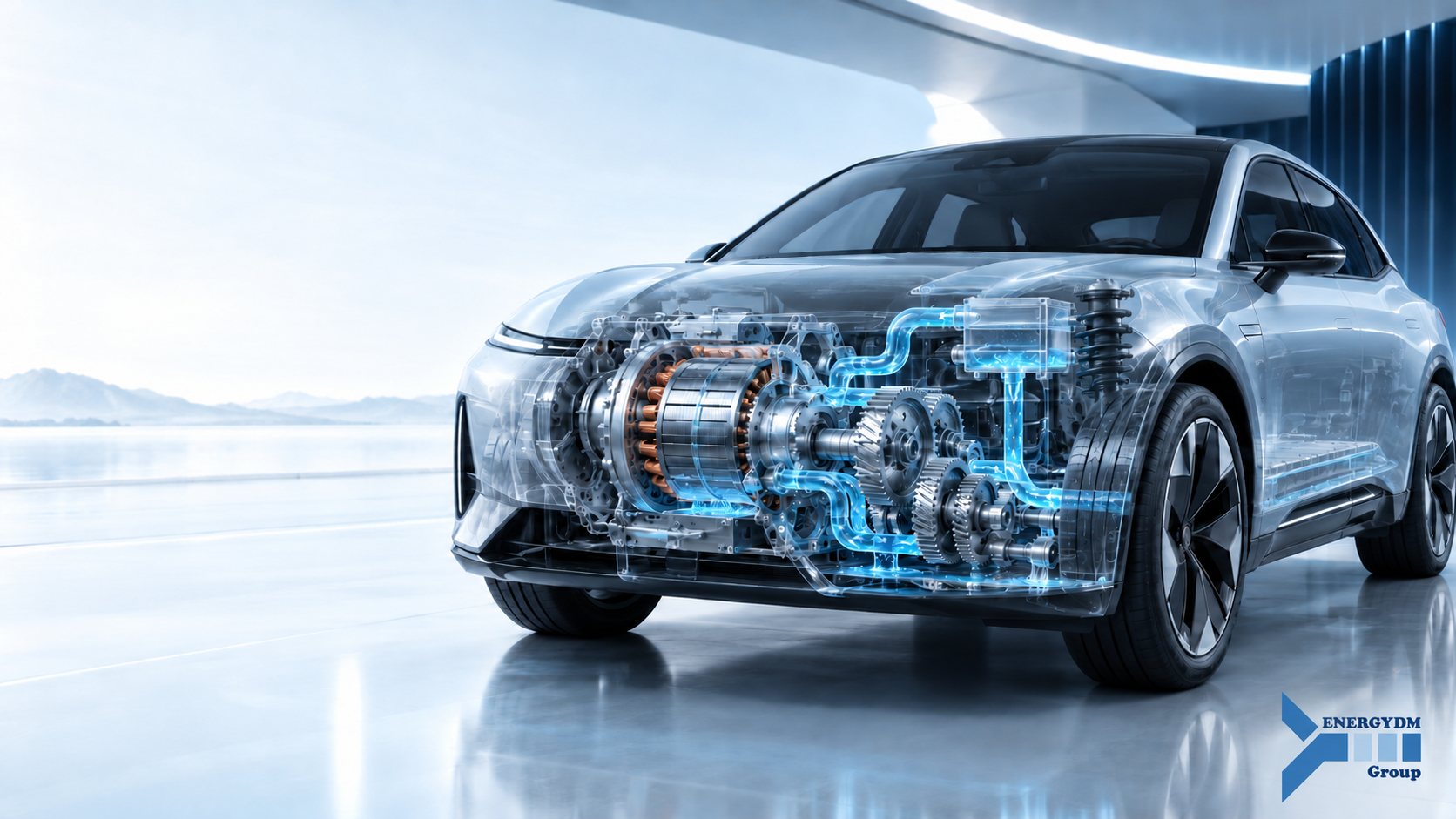
Modern electric drive units (EDUs) still need a working fluid. In fact, they often need one that pulls double duty: lubricating high-speed reducer gears and bearings, and cooling the electric motor and surrounding power electronics.
The same fluid. At the same time. While staying electrically insulating enough to bathe copper windings without causing trouble. That’s a tall order, and it’s the exact problem that companies as TotalEnergies set out to solve.

A fluid built for an electric world
If you’ve ever flipped through an EV powertrain cutaway, you’ve seen the choreography: a permanent-magnet motor spinning at 15,000-plus RPM, a single- or two-speed reducer translating that to wheel torque, and a stack of inverters and DC/DC converters managing kilowatts of energy flow. Heat, friction, and stray voltage are all part of the deal.
The old way — water-glycol for cooling, a separate oil for the gears — works, but it’s heavy, complex, and increasingly out of step with where the industry is heading. EV thermal management today is a layered system: a low-temperature loop for the battery, a high-temperature loop for the drive unit, motor, and power electronics, and an AC refrigerant loop for the cabin. Consolidating that high-temperature loop into a single, smart fluid is where companies see the future.

A promising product named Quartz EV-Drive MP is built around what TotalEnergies calls Insulat·Ion Augmented technology. Translation: a synthetic formulation tuned to handle three jobs at once — insulate, cool, and lubricate.
The headline claim is that its dielectric properties are 50× better than conventional products, which sounds like marketing math until you see the IEC 60156 dielectric breakdown number: 97 kV/mm. That’s serious headroom against short-circuit and static-discharge risk inside an energized stator.
Does it actually work? The 100 000 km test
Here’s where the story gets more interesting than a spec sheet.
A real-world fleet validation on Tesla Model 3s: half the cars filled with the OEM fluid, half with Quartz EV-Drive MP. The campaign ran on two driving cycles with matching profiles: one in Germany, one in China.
Vehicles ran at least six days a week, two shifts a day, multiple drivers in rotation, slow-charged overnight and fast-charged during the day. The point was to stress the fluid the way real fleets do.
After 100 000 km, two findings stood out:
- Viscosity stayed flat. Quartz EV-Drive MP held steady at roughly 4.7 cSt at 100°C across the entire test — lower than the reference fluid and remarkably stable. That’s exactly what you want for efficiency.
- Wear went down. Iron and copper content in the oil, proxies for gear and winding wear, climbed more slowly with Quartz EV-Drive MP than with the reference. The motor stators came out clean: no corrosion on wiring, no damage to insulation materials.
There was also an efficiency angle. In a CLTC efficiency test, vehicles running Quartz EV-Drive MP saved 0.382 Wh over the original manufacturer lubricant using the same EDU. Small per mile. Not so small over the life of a fleet.

The cousin in the battery pack
A similar product for lithium-ion batteries named Quartz EV-Battery is ready for the other thermal frontier: immersion-cooled batteries. Four formulations cover the trade space:
- Eco-Friendly — low viscosity, made from renewable carbon, negative carbon footprint.
- E-Cool — ultra-low viscosity tuned for maximum cooling performance.
- Cell-Shield — high auto-ignition (>403°C) and thermal-runaway prevention focus.
- S-Cool — designed for batteries without active fluid circulation, with the highest thermal stability of the four.
And this matters because the industry is moving in exactly this direction. Independent market analysts call out the shift toward dielectric and immersion cooling fluids as a defining trend, with the EV dielectric fluid market projected to grow from roughly USD 1.55 billion in 2025 to USD 5.62 billion by 2035, a 13.75% CAGR. That’s not a niche anymore. It’s where serious R&D and OEM attention are landing.
Why this matters beyond the brochure
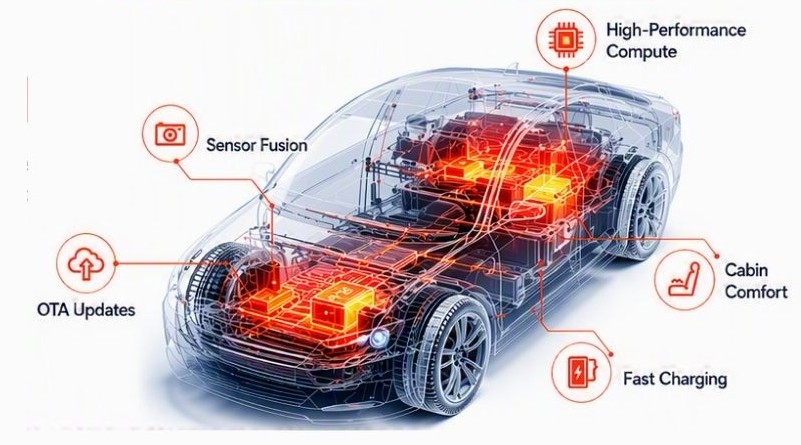
The narrative around EVs, and increasingly around software-defined and AI-defined vehicles, tends to fixate on chips, code, and compute. Fair enough. But the vehicle still has to move, and how well it moves depends on a stack of physical enablers that mostly nobody talks about.
Drive unit fluid is one of those quiet enablers. Get it right, and you unlock lower viscosity (efficiency), tighter packaging (fewer cooling circuits), longer service intervals, and a measurable wear margin on the hardware that has to last 15-plus years.
Get it wrong, and the slickest software stack in the world won’t save you from a stator failure at 80,000 km.
For OEMs, suppliers, and anyone tracking where EV (and now AIDV !) engineering is actually going, the multi-purpose dielectric fluid story is worth watching closely. The electric era didn’t kill fluids. It made them more interesting.